Part 4 of 6.
I open my eyes every morning and reach for my iPad, just to check if the world has survived the night without my motherly care. Sure enough, there is trouble brewing in Tibet – a friend from Nepal writes that Tibet will be off limits to all foreigners from June 25 through July 25, 2011. The Chinese authorities apparently expect “unrest” among the Tibetan population to commemorate the 60th anniversary of Chinese takeover of the region.
We have just returned from Lhasa and this news strikes a raw nerve – we have missed the travel ban by just a few weeks! No wonder that we witnessed the Chinese military flooding the streets of Tibetan capital! Could it really be that the city will burn and its people will be hurt? Quite possibly… Can the Tibetans civilians stand a chance against the professional Chinese army and security forces? Very doubtful…
I’m not going to debate the finer points of the convoluted Tibetan – Chinese history, but I’d like to tell you about my own feelings after visiting Lhasa, if only for a few days.
First and foremost, I expected to see a mystical city full of monks and shrouded in traditional ceremonies. Call me naive and you’d be absolutely correct.
What I saw was a modern city with lots of stores along the long straight boulevards. instead of the monasteries I saw museums, instead of meditating lay people I saw the Chinese armed patrols, instead of the lama’s – cellular towers, security cameras, “liberation” monuments and red flags with five yellow stars.
The progress came to the land of monks and nomads and it has delivered the high-speed internet (albeit censored), comfortable hotels with hot running water, English-speaking tour guides, decent roads and the modern airport. However, something was lost in the process. That something was about 98% of all Buddhist monasteries, which were either destroyed or shut down. That something was more than one quarter of the native population, which was either killed or imprisoned during the Cultural Revolution. That something was the influx of hundreds of thousands Han Chinese into the Tibetan plateau – someone had to re-educate the natives, establish new culture and new political order.
Sixty years have passed since the occupation of Tibet and the end result of Tibetan assimilation is not clear. After all, the Chinese still have reasons to believe that they must completely seal off the region from the rest of the world a few times a year for 30 days at a time!
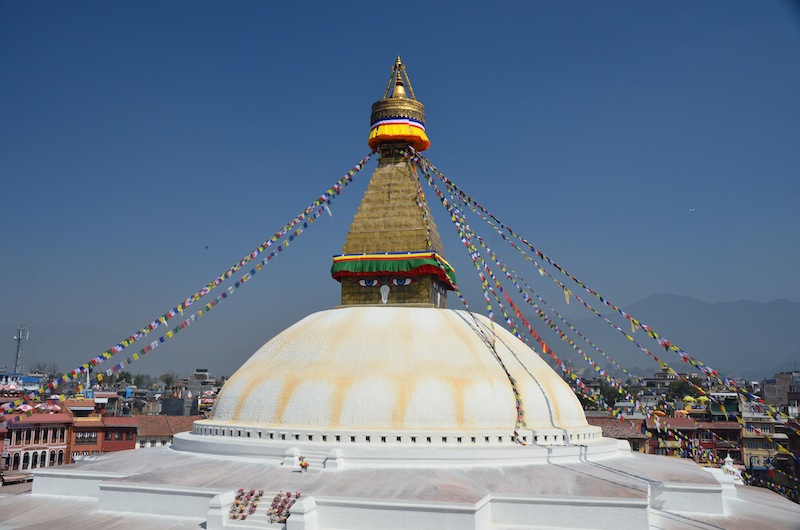
However, the Tibetan culture is very much alive and you don’t need to hold a Chinese permit to see it. Go to Kathmandu, Nepal, and stroll through the Tibetan refugee areas. You will see the amazing monasteries, crowds of devoted Buddhists prostrating themselves in front of the temples and spinning the prayer wheels. You will hear the ancient chants and modern “techno” interpretation of the traditional Tibetan music. You will be handed a portrait of Dalai Lama as you walk clockwise around the magical Stupa of Boudha, never mind that even pronouncing his name was forbidden in Lhasa until recently.
Perhaps, now Nepal is a better place to meditate, pray and learn about Tibet than Tibet itself. It may change in the future, although I wouldn’t bet on it!
Keep on traveling,
Lenka info@lenkatraveler.com